
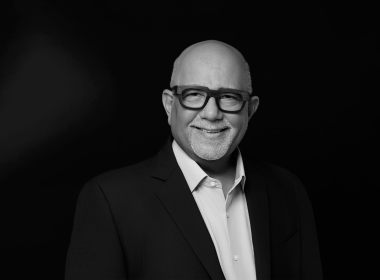



Most leadership problems get blamed on people. However, those failures usually trace back to the system those people are working inside — the one that was built poorly, or never really built at all. Samantha McCue, an aerospace leader and entrepreneur who has spent her career building and scaling teams in environments where technical complexity and safety are non-negotiable, applies a discipline to leadership design that most organizations reserve for engineering technology. “A strong leadership model is a set of operating mechanisms that produce consistent decisions,” McCue says. The standard she holds leadership systems to is the same one applied to flight-ready hardware: designed, tested, stress-tested, and continuously improved.
Design Leadership Like a Technical System
In safety-critical engineering environments, McCue argues, individual judgment cannot be expected to fill the gaps left by organizational design. When decision rights are ambiguous in an aerospace program, the result is rarely creative problem-solving. It is delayed escalation, duplicated effort, and added risk.
“Define who decides what, at what level, with what inputs, and on what timeline,” McCue says. She draws a distinction between organizations that describe themselves as collaborative and those that can point to exactly when a trade gets escalated and who makes the final call. The second kind, in her experience, tends to perform better under pressure.
Her recommendation is to document decision rights the way engineers document the interfaces between subsystems, then stress-test them against real scenarios before the pressure arrives. Organizations that leave decision authority implicit, she said, tend to discover the cost of that choice on the flight line rather than in the conference room.
Train Leaders to Think Like Systems Engineers
When outcomes start to slip, McCue said, the common instinct is to push harder on the people producing them. She believes the more useful intervention sits upstream, in the system shaping their behavior in the first place.
“The real leverage is upstream in the system that shapes behavior,” she says. Incentives, metrics, escalation paths, and meeting cadences all send signals to a team, and over time those signals harden into a culture that determines which behaviors are easiest and most rewarded. She offered two examples. “If you reward speed but punish bad news, you will get optimistic reporting and late surprises,” she says. “If you say safety first but schedule pressure makes it impossible to check and recheck assumptions, you are designing failure into the process.”
In McCue’s view, recurring problems tend to be evidence of design flaws rather than individual shortcomings. The work, then, is to map the inputs, constraints, and feedback loops and adjust the system until the right behavior also happens to be the easiest one.
Make Risk Speakable Before It Becomes Expensive
In safety-critical work, McCue said, the ability to surface risk early is a requirement rather than a cultural preference. The teams that handle risk well, in her experience, are the ones that have built the structure and the psychological safety to name a problem clearly and work it aggressively before it compounds.
“Make it normal to raise a concern with evidence, and make it safe to be wrong,” she says. The mechanisms she uses are deliberately simple. She favors prompts that surface assumption risk early — an example might be what would have to be true for the plan to work.
She also recommends a short weekly rhythm focused on assumptions, interfaces, and changes rather than on assigning blame, and a metric that tracks how quickly risks are escalated and resolved, not just how many are logged. “The best aerospace teams cannot avoid risk,” McCue says. “They surface it early, name it clearly, and manage it aggressively.”
The Leadership Model as a Competitive Advantage
The mechanisms McCue describes — clarifying decisions, engineering culture, surfacing risk early — are not unique to aerospace, and she has applied the same discipline outside the flight line in building and scaling several businesses. Her argument is that any organization operating under genuine complexity and consequence will eventually pay for the leadership system it failed to design.
Treating leadership design with the same rigor applied to systems engineering, she said, tends to produce organizations that perform consistently under pressure, rather than ones that depend on a few exceptional individuals to make up for structural gaps.
Her closing prescription is small enough to act on this week. “Pick one recurring problem and ask, what in our leadership system is producing this result?” she says. “Then redesign that mechanism and measure the change.” In organizations where recurring problems are treated as people problems, that question rarely gets asked. In the ones that hold up under pressure, it tends to be the first one.
Follow Samantha McCue on LinkedIn for more insights on aerospace leadership, systems thinking, and building high-performance teams in complex environments.