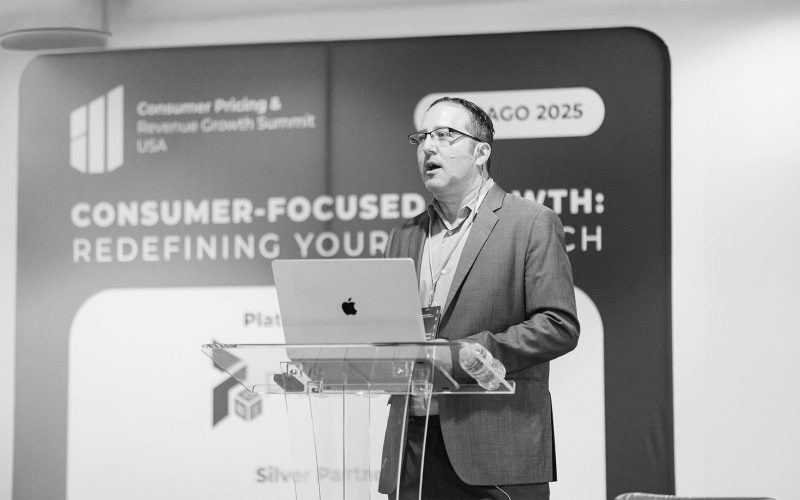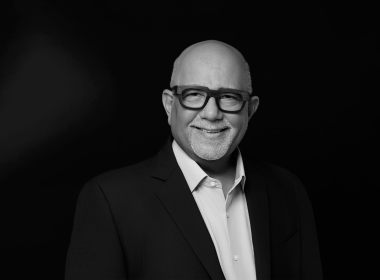




The technology that helped take down Osama bin Laden did not start as a military operation. It started as a commercialization problem. The EOTech holographic weapon sights existed before Keith Blakeley got involved. Delta Force operators were buying it on their own credit cards because the procurement system had not kept up with their needs. Blakeley acquired the technology, transformed the commercial strategy around it, and today EOTech is on 80% of law enforcement and military weapons in the United States.
That trajectory, from overlooked innovation to dominant market position, is the work Blakeley has spent decades learning to replicate. As Chief Executive Officer (CEO) of The InVentures Group, he has led and advised technology businesses across advanced materials, nanotechnology, energy, and consumer products, including work on the Chernobyl disaster response. “The winners aren’t the ones with the most ideas,” Blakeley states. “They’re the ones who can execute the right idea at scale.”
Science Creates Advantage, But Only If You Translate It
Technical industries have a persistent problem. The people building the technology fall in love with the science, and they should, but the market does not reward science. It rewards outcomes. Better performance, lower cost, higher reliability, faster adoption, measurable return on investment. Science has to travel through a translation layer before it becomes commercially defensible, and most technical founders skip that layer entirely.
The translation Blakeley describes is a specific sequence: scientific capability becomes product advantage, product advantage becomes customer value, customer value becomes a defensible market position. Each step requires a different kind of thinking, and the failure to make each translation explicit is why so many technically superior products lose to commercially superior competitors. “If you can’t explain your edge without a slide full of formulas,” Blakeley reflects, “you don’t yet have a commercial story. You have a research story.” When the translation is done correctly, something important shifts; the science stops being impressive and starts being strategic leverage.
Strategy Is Focus. Focus Is Speed
Industry leaders are not leaders because they pursued every opportunity available to them. They are leaders because they were disciplined about where they played and how they chose to win. That discipline requires making hard, specific choices: which market segment to adopt first, which buying center to target, what the simplest product looks like that proves the value proposition, and what conditions must be true for scale to work, supply chain, quality, regulatory, and unit economics.
The failure mode Blakeley sees consistently is organizations trying to maximize opportunity and instead maximizing distraction. The discipline to say no to opportunities outside the defined focus is not conservative; it is what drives speed. Speed generates learning. Learning generates momentum that competitors cannot replicate, because they are still trying to do everything at once.
Scale Is a System, Not a Desire
A prototype can generate excitement. Scale generates leadership. The two are separated by a system that most organizations underestimate until they are already behind: manufacturing readiness, yield consistency, cost reduction, quality controls, distribution channels, customer support, and strategic partnerships that provide access to existing markets.
The factory is often the real competitor, not the rival company with inferior science, but the operational gap between what can be demonstrated and what can be reliably delivered. EOTech is the clearest illustration. The technology was real, and the need was proven. What transformed it from a product that special operators were buying out of pocket into a product with 80% market penetration was the commercial system built around it. Science, strategy, and scale are not sequential phases. They are one integrated system, and leadership comes from running that system better than anyone else, technical credibility combined with commercial judgment, operating together rather than in isolation. Build that integration, and you are not just building a product. You are building a position the market cannot deny.
Follow Keith A. Blakeley on LinkedIn for more insights on technology commercialization, advanced materials, and building the systems that turn scientific innovation into industry leadership.